ShotIQ Learn/📡 Launch Monitor Metrics
Reading Your Shot Dispersion
Every club has a pattern. Hit thirty 7-irons and they don't land on one spot; they land in a cloud — some long, some short, some left, some right. That cloud is your dispersion, and it matters more than your average carry: the average tells you where the middle is, the pattern tells you where the ball can actually go.
On this page
ShotIQ draws each club's pattern in My Bag › Dispersion. This page explains how to read it, and why its shapes are a little bigger than you might expect.
Two windows, one centre
Each club gets two shapes, centred on its own average landing spot — not on the target:
- The filled window holds about 68% of the club's shots — roughly two in three. This is where the club usually goes.
- The outline holds about 95% — 19 in 20. This is where it nearly always goes. Plan around this one when there's trouble.
- The + marks the average. Its distance from the centre line is your lean.
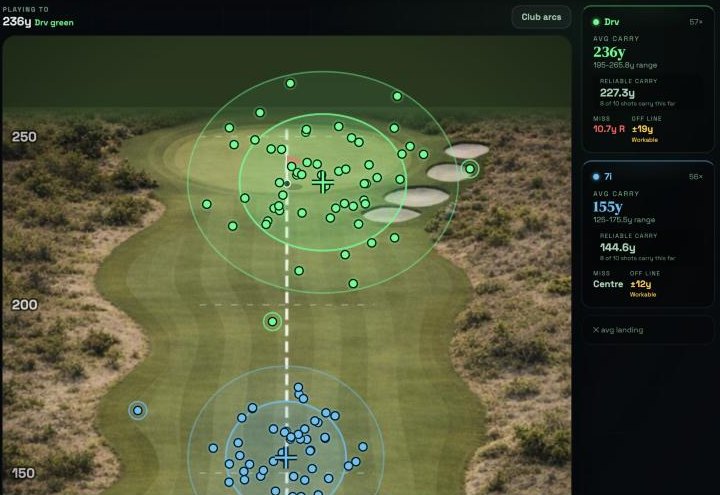
Shots drawn hollow are mishits (thin or fat, judged against that club's own usual strike). They stay on the map so you can see them, but they're kept out of the windows, so one chunk doesn't redraw the whole pattern. A shot with a ring around it finished outside the 95% outline. Tap any shot to see its carry, how far left or right it finished, and whether it was inside your usual window; ‹ › and Browse shots step through them.
Course draws the shots on a hole; Scatter puts them on a plain chart with yards on both axes. More holds Heat — where one club's shots cluster, with the club picked on the map — and 3D flight. Fit shots zooms the map to where your shots actually land. Whole hole pulls back to show the tee as well.
Why the outline looks wider than "2 standard deviations"
If you've seen the rule of thumb that 68% of results fall within one standard deviation and 95% within two, you might expect a 95% window two standard deviations wide in each direction. That rule is for one number at a time — carry alone, or side alone.
A landing pattern is two numbers at once. A shot that's a little long and a little wide falls outside an oval even when each number alone is ordinary, so a 1 × 1 standard-deviation oval holds only about 39% of shots, and a 2 × 2 oval only about 86%. To really contain 68% and 95%, the shapes have to be bigger:
| Window | Size (in standard deviations) | Shots inside |
|---|---|---|
| Filled | 1.51 | 68% (about 2 in 3) |
| Outline | 2.45 | 95% (19 in 20) |
So when ShotIQ says 19 in 20 land inside this window, it is literally true of the shape on the screen. We checked it against thousands of simulated shots.
The pattern is also robust: a single wild shot is pulled in before the spread is measured, so one shank doesn't make your 7-iron look like a driver.
The same shapes everywhere. The caddie's ring on the course, My Sessions, the Gapping column, Compare, Scoring Windows, Quick Caddie and Log a Shot all draw the same way: a filled 68% window, a thin 95% outline and a + at the average. Learn to read it once and you can read it anywhere in ShotIQ. (In the Gapping column each club is one row, so its two windows are left to right only — and for one direction at a time, ±1 and ±1.96 standard deviations really are 68% and 95%.)
What your pattern says
Under the map, What your pattern says gives every club one plain sentence, from fixed rules:
7i Finishes 6y right of your line on average. 19 in 20 land inside a 29y-wide window, 141–166y carry. Aim 6y left to centre it.
Every number in it is one the map draws: the average finish is the +, the width and carry span are the outline's.

When is a lean worth aiming for?
An average miss to one side is tempting to aim away from. ShotIQ suggests an aim only when both of these are true:
- It's big enough to matter — at least 4 yards. A smaller lean is lost inside your normal spread.
- It's bigger than chance — more than twice its own uncertainty. With a wide pattern and only a few shots, the average can sit several yards off-centre purely by luck; the uncertainty shrinks as you hit more shots.
It also needs at least 8 shots with side data. When a rule isn't met, the sentence says which: close enough to centred — aim at your target, that lean isn't reliable yet — keep aiming at your target, or how many more shots it needs.
Off line
Each club's card also shows Off line: how far its shots finish from the target line on average. Unlike the windows, it includes your lean — a club that's tight but 10 yards right of the target still finishes 10 yards off line. A big Off line with a small window means the fix is your aim or alignment, not your swing.
Before vs since your focus
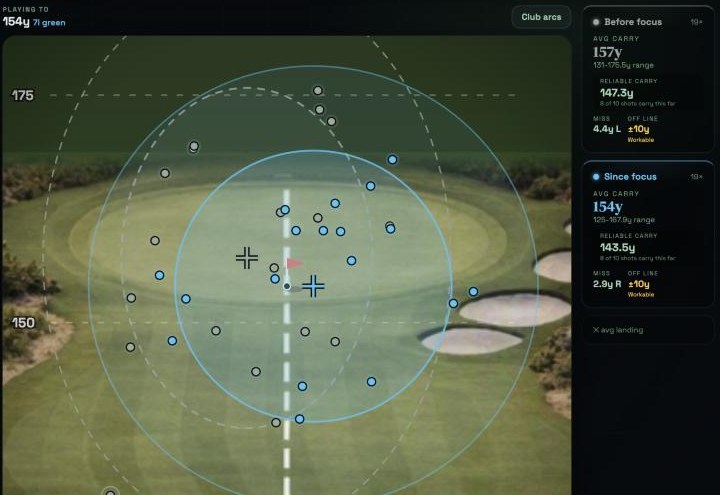
If your Game Plan focus is on a club, add that club to the map and tap Before vs since focus. Its pattern from the 30 days before you started is drawn dashed, beside the pattern since. Under the map is the same verdict your Game Plan gives — your work is showing up, no meaningful change yet, or too early to call — so you can see the change and know whether it's real.
Range, course, or both
The Range · Course · Both switch at the top of My Bag picks which shots the map reads. Course shots logged against an aim have a real left-right number; course shots logged without one count for distance only, and sit on the centre line.
Frequently asked questions
Why is my 95% window so wide? Because it really contains 19 of every 20 shots, in both directions at once. A two-dimensional 95% window is 2.45 standard deviations across, not 2.
Why doesn't ShotIQ tell me to aim off for every club? A lean under 4 yards isn't worth re-aiming for, and a bigger one from a few loose shots may be chance. It suggests an aim only when the lean passes both tests.
Are mishits counted? They're shown, hollow, but left out of the windows and the sentence. Judged against each club's own strike, so a thin wedge and a thin driver are each judged fairly.
How many shots do I need? The windows appear from 3 shots with side data. An aim needs at least 8, and the picture steadies as you add more — see How many shots before your average means anything?.