The Round Debrief
Most golf stats tell you what your score was made of. They don't tell you whether you should have hit that shot. A 3-wood into the water can be a poor swing at the right target, or a good swing at a target you should never have picked. Those two need opposite fixes, and a scorecard can't tell them apart.
On this page
The Debrief does. It judges every shot you log, on the same model as the simulator, and keeps two questions apart:
- The call. Was that the right club and line, from that spot, for your game? This is what it cost against the best play available, before the ball was struck.
- The strike. Given that play, how did it come off? This is how the ball finished against what your own shots usually do from there.
Both are in strokes, measured at your handicap, using your own shot pattern. That second part matters: the right play for a tour player can be the wrong one for you, and the Debrief judges you against your game.
It's there for every round, by default, whether or not you used the caddie.
The examples on this page are from a sample round: real output from the app, on a real course, with simulated shots.
What you get
Open any round. Under your score is The Debrief.
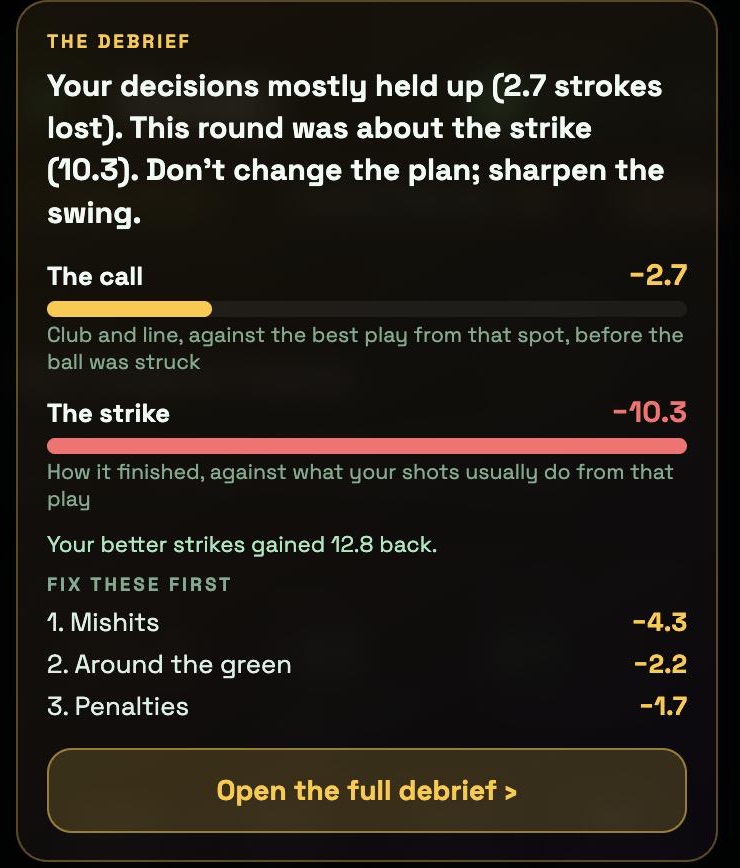
The headline says what kind of round it was. Here: "Your decisions mostly held up (2.7 strokes lost). This round was about the strike (10.3). Don't change the plan; sharpen the swing." A golfer who read only their score might have gone home and changed their strategy. This says not to.
Tap Open the full debrief for the rest.
Fix these first
Three priorities, ranked by what they cost, each with the evidence, what to do about it, and the holes it happened on. Tap a hole to jump to it.
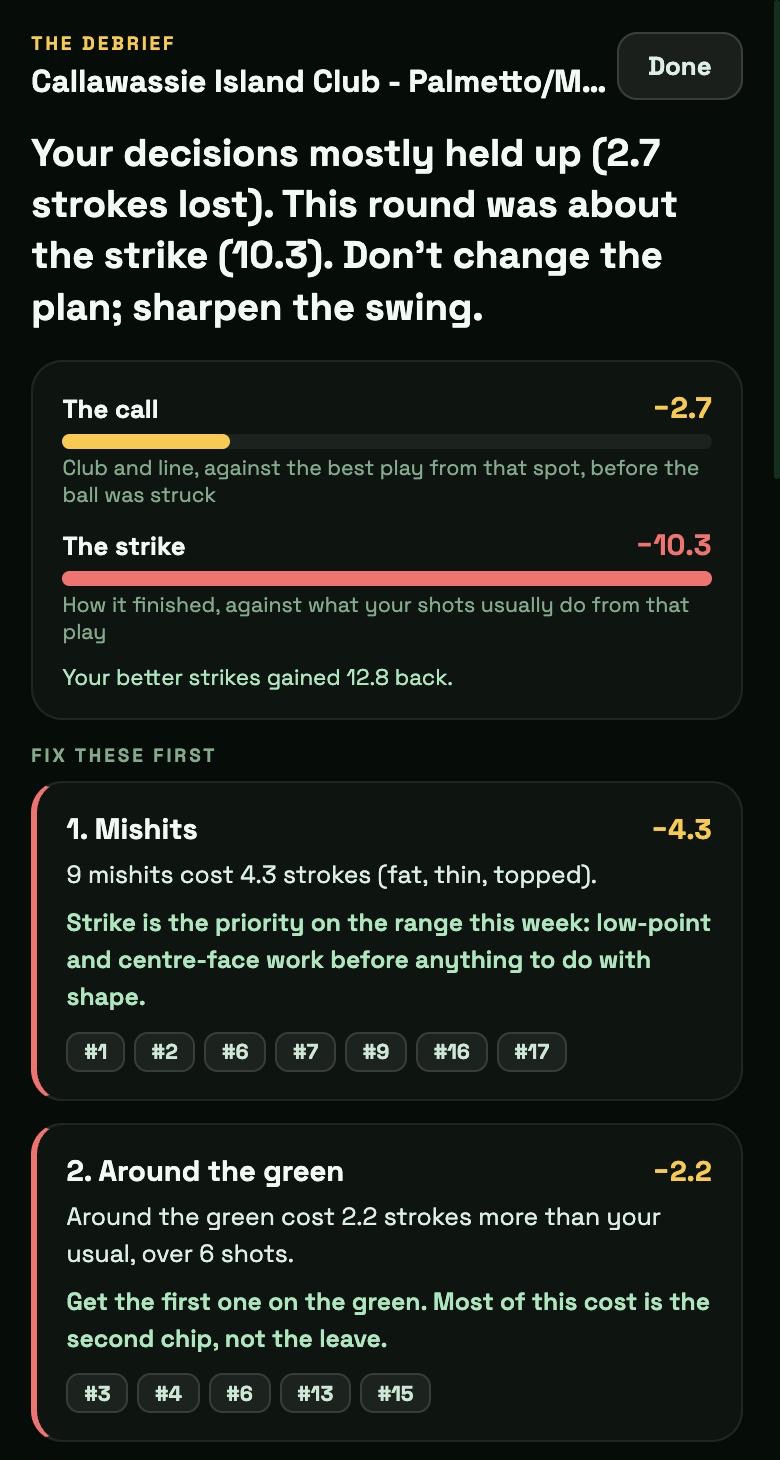
ShotIQ looks for:
- Coming up short or flying it long: how many approaches finished short of the flag, and by how much
- A miss to one side, with the aim that allows for it
- Tee-shot choices, club selection and target lines: strokes given away before the ball was struck
- Bets that paid: shots that came off, but shouldn't be repeated
- Penalties, mishits, the short game and three-putts
- Big numbers: how much of your over-par came from doubles or worse
- After a big number: whether a bad hole spilled into the next one
- Closing holes: whether the last three played harder than the rest
Nothing is called a pattern from a couple of shots: it takes at least three, and most of the shots have to agree.
Every hole, every shot that matters
Open a hole for its story, what your game usually makes there, and the shots worth looking at, drawn on the real hole.
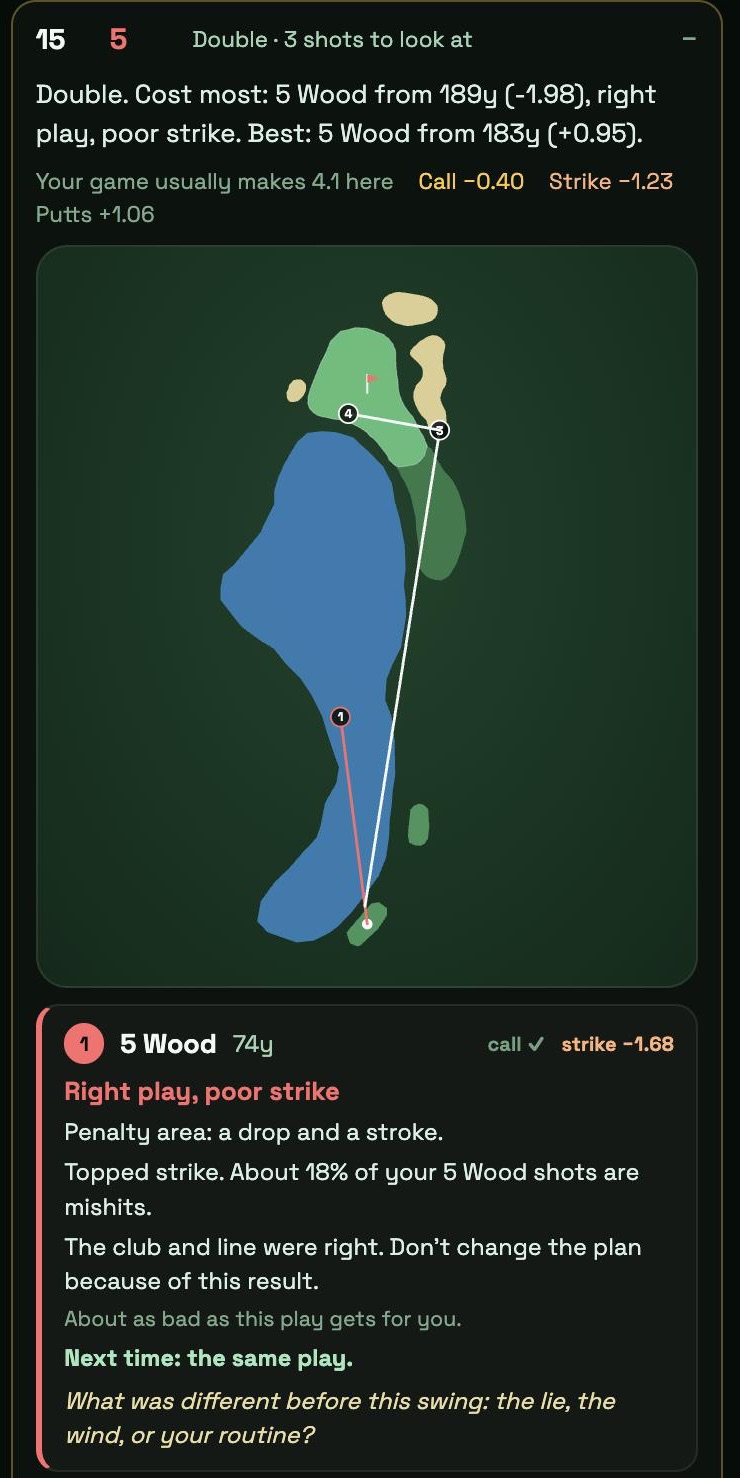
This hole shows why the two questions need keeping apart. The double looks like one bad hole. The Debrief finds three different things:
Shot 1, 5 Wood, topped into the water: Right play, poor strike. Penalty area: a drop and a stroke. Topped strike. About 18% of your 5 Wood shots are mishits. The club and line were right. Don't change the plan because of this result. Next time: the same play.
Shot 3, 5 Wood from the rough, 171 yards: Got away with it. Finished 16y right of the line. That's your usual miss: 57% of your 5 Wood shots go right. The result was good; the decision wasn't. Don't let the score teach you this one. Next time: 3 Wood, 22y left of where you aimed. Worth 0.40 a shot.
Shot 4, Sand Wedge from 27 yards in the bunker: Poor bunker shot. This left 29 ft, worth 0.53 more than your usual from there.
Each shot gets one of these verdicts:
| Verdict | The call | The strike | What it means |
|---|---|---|---|
| Well played | Right | Better than usual | Bank it |
| Right play, poor strike | Right | Worse than usual | Don't change the plan |
| Got away with it | Wrong | Came off | Don't let the score teach you this |
| Bad bet | Wrong | About usual | The price was too high |
| Wrong play, and it cost you | Wrong | Worse than usual | The first thing to change |
| A better play was there | Close | Fine | Worth knowing |
Key shots also come with a question, because some of this only you can answer. "Which number did you pick the club from: your good one, or your usual one?" "About 2 in 10 find trouble from this play. What was the upside worth to you, on this hole, at this score?"
Against any level
For college players and anyone chasing a level, strokes gained by part of the game can be read against PGA Tour, +3, scratch or your own handicap. One tap, same shots.
During the round
The Debrief is written as you play.
Look back at any hole. Go back to a hole you've finished and its recap is a tap away, with the same verdicts. It's also in the caddie sheet and the scoring sheet.
The caddie speaks up. Walking onto a new hole, if something's repeating, your caddie says so, once:
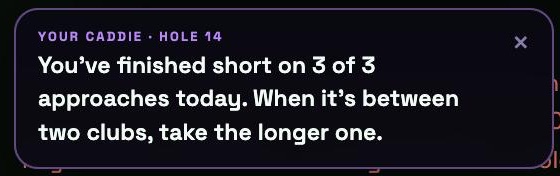
It can tell you when your miss has settled on one side, when penalties mean it's time to choose Safe, when mishits suggest more club and an easier swing, and after a big number, simply to pick a target and move on. If you're making good decisions it says that too. It says each thing once, and what it told you is kept with the round.
The round so far sits at the top of the caddie sheet: where you stand, the running split, what's repeating, and what past rounds found.
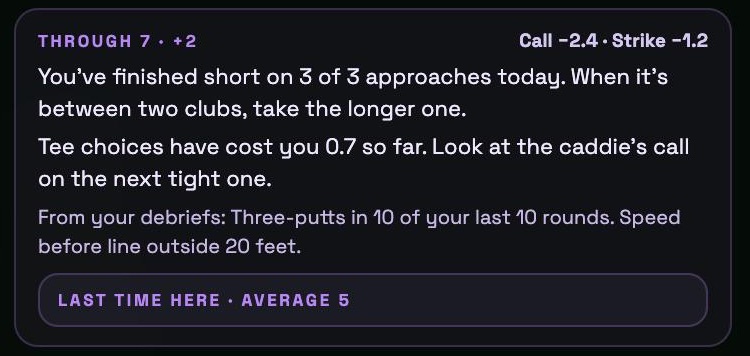
The caddie's numbers move too. Today's shots count first in your pattern, up to a third of it, so a driver going right today shifts where the caddie and the simulator expect it to finish. Together with today's form, it's playing the golfer you are this afternoon.
Tournament Mode shows none of this during play, so nothing on the screen is advice during a competition. The full debrief is waiting when you finish. If your event has its own rules on devices, follow those.
It gets smarter
Each debrief is kept with its round, and over rounds they add up:
- What keeps coming up. A pattern that shows in at least two rounds and 40% of your last ten becomes a lesson: "Over your last 6 debriefed rounds you've run short of the flag in 4. Club up when it's between two." You'll see it in the caddie sheet, and your AI coach reads it.
- What this hole has cost you. Back on a hole you've played, the caddie has what the last debrief said: your average there, and the next-time note from last time.
- Your pattern, your numbers. Every logged shot feeds your shot pattern and Caddie Numbers, and shots on this hole count most on this hole.
For your coach
A coach you share rounds with sees every debrief in their Coach Hub automatically, including the priorities and the key shots. It also goes into the brief they get before your lesson.
For anyone else, three exports sit at the bottom of the debrief:
- PDF report: a clean, printable report with the summary, priorities, levels, hole-by-hole table and every key shot with its reasoning
- Shot data (CSV): every shot with its costs and verdict, for a spreadsheet or a team's own tools
- Copy text: the summary, to paste into a message
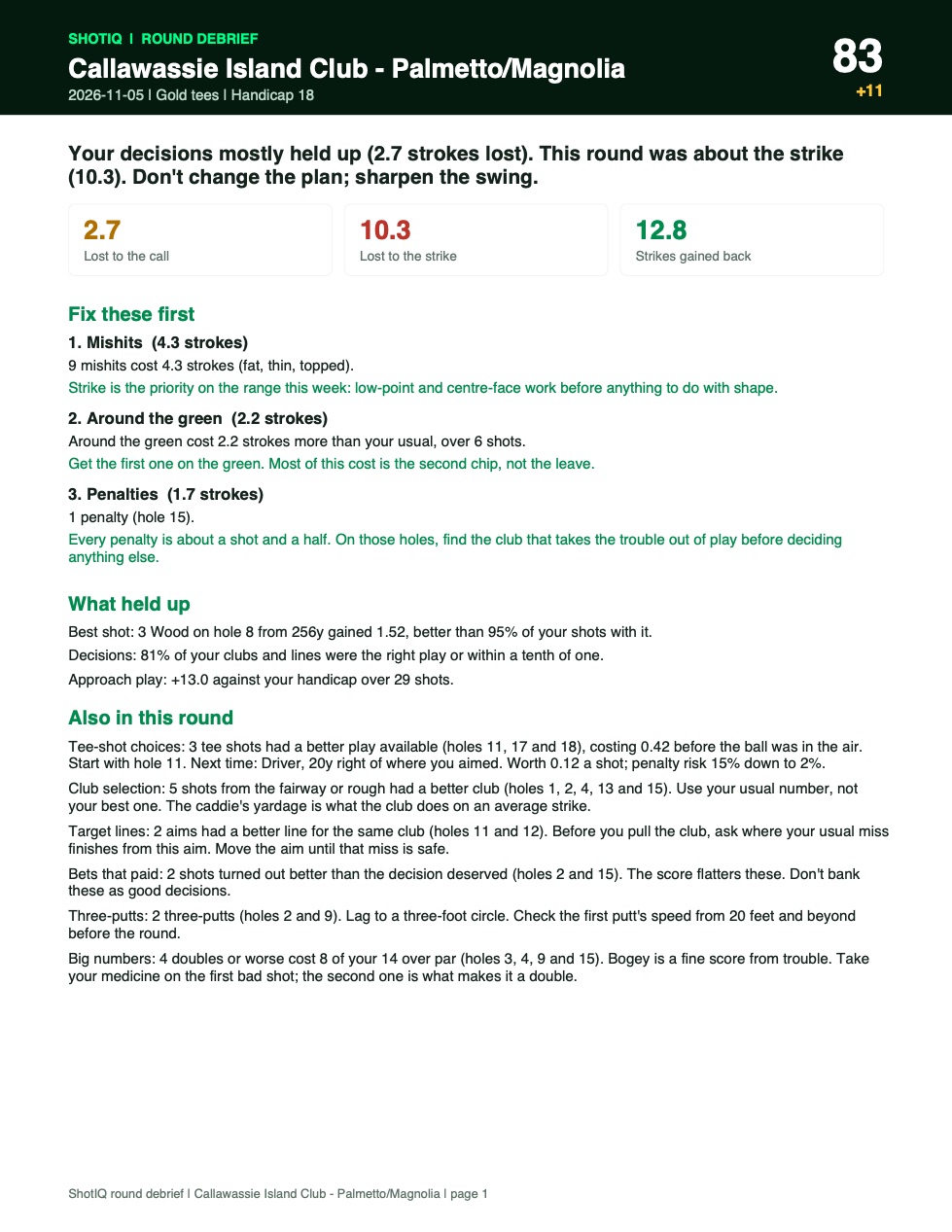
Talk it through with AI takes the debrief to your AI coach, and Practise the first one goes straight to practice.
How far to trust it
We want a good player to be able to read this and agree with it, so here's what it rests on.
We tested it against itself. If a golfer plays exactly what the model recommends and hits exactly what the model draws, the Debrief should find nothing. In our test over 305 shots, those shots averaged a call cost of 0.02 strokes and a strike within 0.05 of zero, so the verdicts aren't leaning against you. That tests the arithmetic, not the golf: real-world accuracy depends on your data.
It's careful about what it knows:
- A line is only judged if you marked your aim. When you log a shot, ShotIQ works out a likely aim for it. That's fine for drawing, but it's not proof of what you meant, so on those shots only the club is judged, and the sheet says so. Set the landing zone before you hit, or move the aim when logging, to get your lines judged.
- An unmapped hole has no trouble on record. Only distance and strike are judged there.
- Small differences aren't called. Nothing under 0.12 strokes gets a verdict, and 0.3 is the line for a poor call.
- It says what it covers, at the bottom of every debrief: how many shots, how many holes, how many marked aims.
- Wind and hills. The wind is recorded with each hole, and each shot's rise or fall is used when it was looked up during the round. Rounds from before this was added, and imported ones, are judged without them.
- A verdict stays with its round. Later changes to your game don't rewrite it. Change the round's shots or scores and it's redone.
It's still an estimate. It doesn't know about a bad lie you didn't log, a gust, or why you really hit that shot. If it says something you know is wrong, you're right, and a logged note is the place to say so.
Rounds without shots
Every round gets what its data can support. With only scores, each hole is read against what your game usually makes there, along with your big numbers and how the round ran. Add putts and it reads those too. Place your shots on the map afterwards, and every shot gets judged.
Keep reading: on the course
- On the course with ShotIQ — every mode at a glance
- Simulate a hole or a round: Safe or Aggressive
- Logging shots: ball flight, shot types and notes
- Caddie numbers: range, course or both
- After the round: review, replay and the round film
- Strokes gained and handicaps
Frequently asked questions
Do I need to use the caddie? No. Every finished round gets a debrief. The more shots you log, the more it can judge, whether or not the caddie was on.
Can I use it in a tournament? Turn on Tournament Mode and nothing shows during play: no tips, no recap, no advice. The debrief is there when you finish. Check your event's rules on devices.
Why was a shot that finished close called a bad decision? Because a good result doesn't make a good decision. If that play finds water 3 times in 10 for you, it was a bad bet that came off. The Debrief says so, so you don't learn the wrong lesson.
Why was a shot in the water called the right play? Because the club and line were the best available for your game, and the swing wasn't. Changing your strategy after that shot would cost you more next time.
Does it work for a good player? It judges you against your own pattern at your own handicap, so it's as demanding as your game. You can also read strokes gained against scratch, +3 or the Tour.
Who can see my debriefs? You, and any coach you've chosen to share rounds with. Nothing is public.